US Healthcare Shortage Area Statistics
A national snapshot of federally designated healthcare shortage areas, computed live from HRSA Health Professional Shortage Area and Medically Underserved Area data. Each figure below is aggregated directly from county-level designations, not estimated.
- 21,166
- HPSA designations
- 4,155
- MUA designations
- 3,291
- counties tracked
- 37.4%
- population in a shortage area
The national picture
According to the Health Resources and Services Administration (HRSA) Data Warehouse, the United States currently carries 21,166 designated Health Professional Shortage Areas and 4,155 Medically Underserved Areas, covering 124,465,607 residents (37.4% of the tracked population), with California accounting for the most residents in a shortage area.
- 37.4%
- of tracked population in a shortage area
- 21,166
- designated HPSAs
- 4,155
- designated MUAs
- 25,866
- additional providers needed
Data as of August 2026. Aggregated directly from HRSA HPSA/MUA county-level designation records.
Key findings
Standalone facts, each computed live from the current dataset and free to quote with attribution.
- • 124,465,607 US residents (37.4% of the 332,942,170 tracked population) live in a federally designated Health Professional Shortage Area, according to HRSA data.
- • HRSA has designated 21,166 Health Professional Shortage Areas and 4,155 Medically Underserved Areas across 3,291 tracked counties in 59 states.
- • 2,935 counties have at least one designated primary-care shortage area, out of 3,269 counties with any HPSA or MUA designation.
- • California has more residents living in a shortage area than any other state, with 23,154,916 people.
- • An estimated 25,866 additional providers are needed nationally to fully resolve designated primary care, mental health, and dental shortage areas.
States with the most residents in a shortage area
Total residents living in a designated shortage area, by state (thousands). Larger states naturally carry larger absolute totals; see the state pages for population-adjusted comparisons.
Shortage designations by type
| Shortage type | Designations with provider estimate | Providers needed |
|---|---|---|
| Primary care | 3,386 | 12,265 |
| Mental health | 2,079 | 5,315 |
| Dental | 2,768 | 8,286 |
Reusable source data
Download the designation records
Download the database-backed HPSA and MUA records used by this reference in CSV or JSON. The export includes source fields and the current portal vintage, not editorially typed values.
The records originate with the HRSA Data Warehouse. They describe structural shortage designations, not real-time appointment availability or care quality. The data contract documents fields, vintage, reuse, and limitations.
Reusable national context
Embed this source-vintaged national snapshot
Use this compact, source-linked summary when a report needs designation totals from the portal's stated HRSA source vintage. It is a reference to HRSA structural shortage designations, not a measure of appointment availability or care quality.
Embed or reuse this visual
Choose the live iframe or a static PNG. Both snippets preserve a source-linked PlainHealthAccess attribution; the PNG link is marked nofollow under the site’s passive-citability policy.
Live iframe
<iframe src="https://plainhealthaccess.com/embed/hrsa-shortage-overview" title="US healthcare shortage designations" width="100%" height="420" loading="lazy"></iframe>Static PNG
<figure><a href="https://plainhealthaccess.com/data/hrsa-shortage-designations" rel="nofollow noopener"><img src="https://plainhealthaccess.com/og/national-shortage-snapshot.png" alt="US healthcare shortage designations" width="1200" height="630" loading="lazy"></a><figcaption>US healthcare shortage designations. Source: HRSA Data Warehouse via PlainHealthAccess.</figcaption></figure>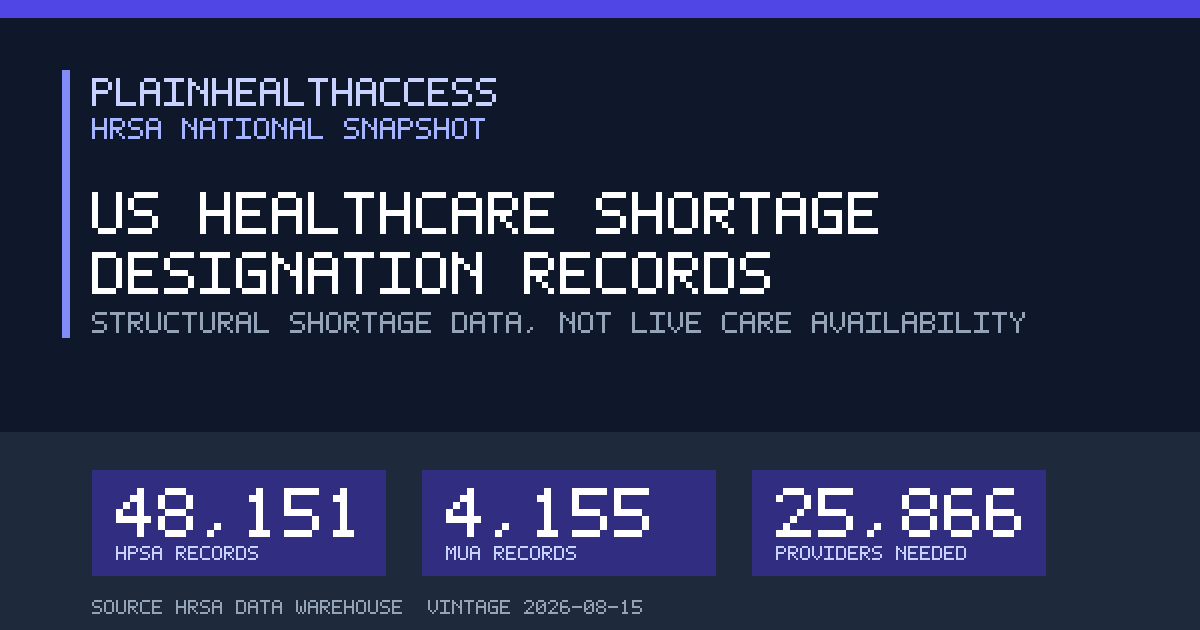
Reading these numbers
A national total hides wide variation by state, designation type, and population density.
- California has the most residents in a shortage area in raw terms (23,154,916), which partly reflects population size, not just shortage severity. Browse by state
- A shortage area is counted at the county level: if any part of a county contains a designated geographic HPSA, that county's full population is included, so a large urban county with one underserved rural pocket counts the same way as a fully underserved one. Read the methodology
- Primary care, mental health, and dental shortages are designated separately, a county can have one, two, or all three, so the national totals are not mutually exclusive counts of unique places. Browse by county
Figures are HRSA HPSA/MUA 2026 aggregates from the portal's stated source vintage. PlainHealthAccess publishes a refreshed snapshot only after a verified HRSA source update. A shortage designation reflects the ratio of providers to population by federal criteria, not a comprehensive measure of healthcare access, and is not medical or insurance advice.