Psychiatrist & Mental Health Shortage by State
States ranked by active mental-health Health Professional Shortage Area (HPSA) designation records from HRSA. A state total is a designation count, not a measure of an individual’s access to care.
The answer
According to the HRSA Data Warehouse, California has 518 active mental health HPSA designations, the highest total in this ranking. These designations describe provider-supply gaps, not care quality, appointment availability, or an individual clinician.
- 6,414
- active mental health designations ranked
- 1,751
- across the top five states (27.3%)
- 86
- median state total
If you or someone you know is in crisis, help is available right now
Call or text 988 (Suicide & Crisis Lifeline), text HOME to 741741 (Crisis Text Line), or call 1-800-662-4357 (SAMHSA National Helpline), free, confidential, 24/7. In a life-threatening emergency, call 911. This provider-shortage data below describes access to routine behavioral-health care, not emergency services.
| # | State | Mental Health HPSAs |
|---|---|---|
| 1 | California | 518 |
| 2 | Texas | 387 |
| 3 | Alaska | 330 |
| 4 | Missouri | 259 |
| 5 | Michigan | 257 |
| 6 | Washington | 217 |
| 7 | Arizona | 212 |
| 8 | Kentucky | 210 |
| 9 | North Carolina | 207 |
| 10 | Florida | 204 |
| 11 | New York | 202 |
| 12 | Illinois | 185 |
| 13 | Louisiana | 173 |
| 14 | Wisconsin | 157 |
| 15 | Iowa | 155 |
| 16 | Minnesota | 141 |
| 17 | Ohio | 132 |
| 18 | Oklahoma | 131 |
| 19 | Oregon | 130 |
| 20 | Pennsylvania | 123 |
| 21 | Virginia | 123 |
| 22 | West Virginia | 119 |
| 23 | Kansas | 115 |
| 24 | Montana | 106 |
| 25 | Indiana | 101 |
| 26 | New Mexico | 96 |
| 27 | Nebraska | 91 |
| 28 | Arkansas | 90 |
| 29 | Mississippi | 86 |
| 30 | Tennessee | 84 |
| 31 | Colorado | 81 |
| 32 | Georgia | 79 |
| 33 | South Carolina | 77 |
| 34 | Puerto Rico | 74 |
| 35 | Maine | 67 |
| 36 | North Dakota | 67 |
| 37 | Idaho | 65 |
| 38 | South Dakota | 63 |
| 39 | Utah | 61 |
| 40 | Alabama | 56 |
| 41 | Nevada | 53 |
| 42 | Massachusetts | 52 |
| 43 | Maryland | 47 |
| 44 | New Jersey | 43 |
| 45 | Connecticut | 41 |
| 46 | Hawaii | 33 |
| 47 | Wyoming | 26 |
| 48 | New Hampshire | 20 |
| 49 | Rhode Island | 14 |
| 50 | Delaware | 13 |
| 51 | Vermont | 12 |
| 52 | District of Columbia | 10 |
| 53 | Federated States of Micronesia | 8 |
| 54 | Virgin Islands | 5 |
| 55 | Guam | 4 |
| 56 | American Samoa | 2 |
What the HRSA Mental Health Data Shows
The HRSA Data Warehouse currently lists 6,414 mental health Health Professional Shortage Area designations across the 56 states and territories ranked above. The three states with the heaviest mental health shortage load are California (518 HPSAs), Texas (387 HPSAs), and Alaska (330 HPSAs). The top five states account for roughly 27.3% of the active mental health designation records in this state aggregation.
States ranked by active mental-health Health Professional Shortage Area (HPSA) designation records from HRSA. A state total is a designation count, not a measure of an individual’s access to care. HRSA documents that HPSAs can describe geographic areas, specific population groups, or facilities. A designation count is therefore useful for comparing this source extract, but it is not a complete estimate of a state’s provider supply or every resident’s care experience. The median state in this ranking has 86 active mental health designation records.
HRSA says that more than 34 federal programs use HPSA, MUA, or MUP designations for eligibility or funding preference. That does not mean every program applies to every record, nor does it establish a person’s eligibility. The figures here are a reproducible state aggregation of the portal’s source-vintaged HRSA records. They describe a federal structural classification, not clinical quality, insurance coverage, appointment availability, or medical advice. For a current record or care decision, use HRSA’s official tools and an appropriate local source.
About Mental Health Shortages
Is there a psychiatrist shortage in the United States?
HRSA currently lists 6,414 active mental health Health Professional Shortage Area designations across the states and territories ranked on this page. That is a federal structural classification of provider-supply gaps, not a count of people unable to get an appointment or a clinical quality score.
What does a mental health HPSA designation mean?
HRSA uses shortage-designation criteria to identify geographic areas, population groups, or facilities with a shortage of mental health providers. This page aggregates active HRSA designation records by state.
What does a higher state total mean?
It means more active designation records in the portal’s current HRSA extract are associated with that state. It is not a direct count of people unable to obtain care, clinicians, wait times, or the severity of any individual situation.
Can this ranking tell me whether I can get an appointment?
No. HPSA designations are structural federal classifications. They do not show real-time appointment availability, insurance acceptance, provider openings, clinical quality, or whether a particular person can receive care.
How can I verify a designation?
Use HRSA’s Health Workforce Shortage Areas tools to inspect the current designation record and its attributes. The data contract linked below explains how this portal processes the source records and labels its vintage.
How should I use this comparison?
Use it to compare the distribution of recorded federal designations across states, then consult HRSA and local or qualified care sources for a current eligibility, service, or treatment decision.
Learn More About Healthcare Shortages
Explore more shortage data
Source: HRSA Data Warehouse Health Workforce Shortage Areas · 2026-08-15 PlainHealthAccess aggregates HRSA records by state and is not affiliated with HRSA.
Embed or reuse this visual
Choose the live iframe or a static PNG. Both snippets preserve a source-linked PlainHealthAccess attribution; the PNG link is marked nofollow under the site’s passive-citability policy.
Live iframe
<iframe src="https://plainhealthaccess.com/embed/shortage-profile?scope=shortage&key=mental-health" title="Mental Health HPSA designations by state" width="100%" height="420" loading="lazy"></iframe>Static PNG
<figure><a href="https://plainhealthaccess.com/shortage/mental-health" rel="nofollow noopener"><img src="https://plainhealthaccess.com/og/shortage/mental-health.png" alt="Mental Health HPSA designations by state" width="1200" height="630" loading="lazy"></a><figcaption>Mental Health HPSA designations by state. Source: HRSA Data Warehouse via PlainHealthAccess.</figcaption></figure>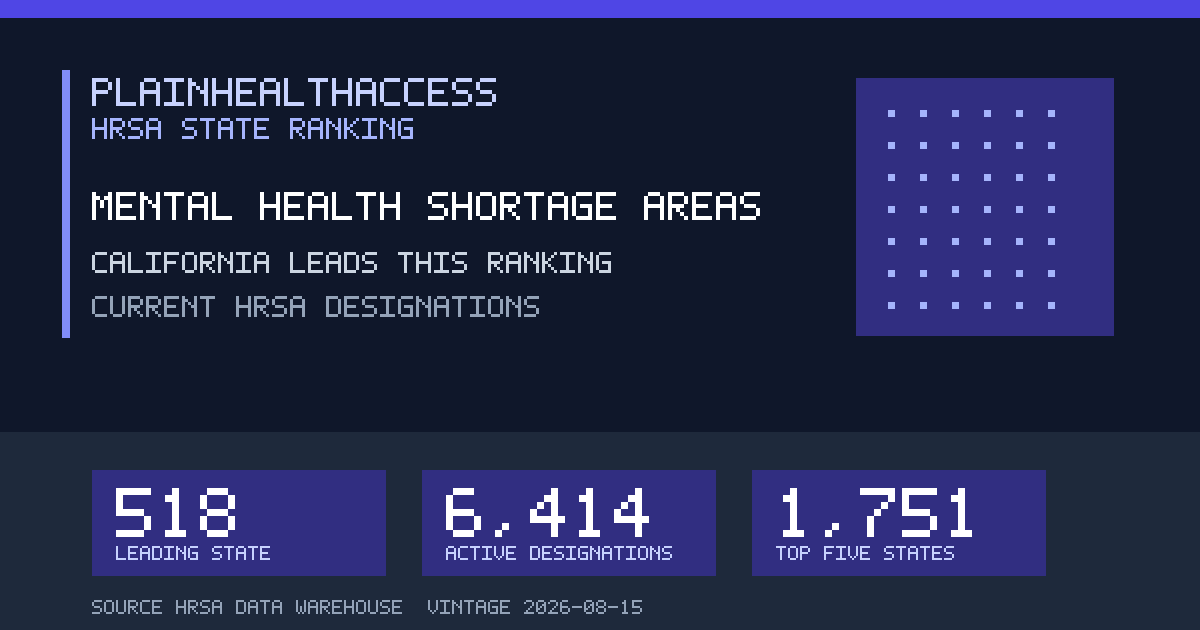
Read our methodology - how this data is sourced, computed, and verified.
Related
Every figure on PlainHealthAccess is rendered directly from HRSA source data, no number is typed in by an editor. This ranking sorts states by designated HPSA count for the selected shortage type. See our editorial standards & corrections policy, the methodology behind these numbers, review the public data changelog, or report a data issue for this page. Data current as of 2026-08-15.